
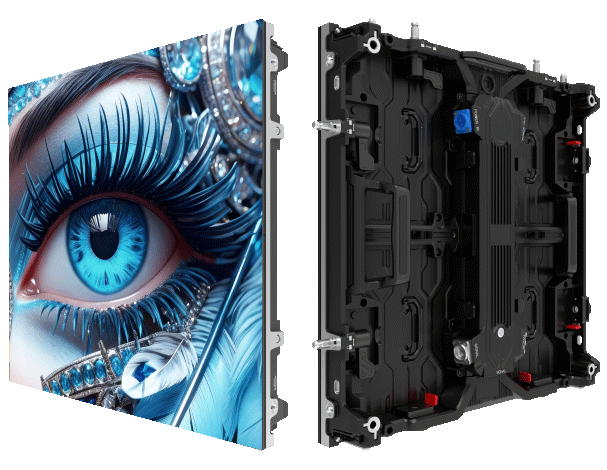
Outdoor LED teams face the same stubborn visual defects again and again: ghosting trails, flicker when panels age, and random bright pixels where a row should be dark. A careful look at modern IC driver architectures helps suppliers and integrators fix those problems early. For teams specifying hardware, reliable led display solutions start with driver features that detect and isolate faults before a show—this saves time and reputation when displays must run under sun, rain, and long operating hours.
Diagnosing the problem: where ghosting and open circuits begin
Ghosting most often traces to timing and current-control issues inside the driver. When PWM timing slips, or when refresh rate and multiplexing aren’t tightly synced, residual charge can produce a faint trail. Open-circuit artifacts occur when an LED column or string goes high-impedance and the driver’s open-circuit detection isn’t aggressive enough to flag or isolate it. At large showcases like CES in Las Vegas, these defects become immediately obvious on big video walls—so real-world events act as a practical laboratory that shows which driver features matter most.
Key driver features that reduce visual artifacts
Modern IC drivers offer a cluster of features that matter in the field. Prioritize chips with reliable current sensing, robust open-circuit detection, and adaptive PWM control. Current sensing prevents runaway brightness when a load changes; open-circuit detection quickly flags disconnected strings; and adaptive PWM maintains consistent grayscale across temperature swings. Add thermal throttling and data-bus error checking for resilient operation during long exhibits. These elements together form layers of protection against visible artifacts.
Practical integration steps for suppliers and installers
Start by matching driver specs to the installation environment. Use controlled layout practices: consistent trace impedance, short return paths, and clearly labeled connectors. Calibrate drivers with real content at the expected refresh rate to expose timing-related ghosting before deployment. Test for open-circuit responses by simulating a cable fault and ensuring the driver isolates the string without cascading errors. Many teams run this validation during pre-shipment checks for Trade Show Display builds—doing so reduces onsite firefighting and improves uptime.
Common mistakes and safer alternatives
Teams often skip end-to-end validation, assume a single-component fix will solve system-level artifacts, or choose cheapest drivers without open-circuit protections. Safer choices include specifying drivers with built-in current sensing and error reporting, and selecting modules that support graceful degradation: the rest of the panel should keep working if one string fails. Opt for a modest hardware cost increase in exchange for fewer service visits—this usually pays back quickly in reduced downtime.
Design patterns that work in the field
Proven patterns include distributed sensing (measure current locally rather than centrally), redundant data paths, and conservative timing margins in multiplexing. Implementing error logs that record open-circuit events and thermal excursions helps with warranty claims and ongoing optimization. Keep firmware updated; many driver vendors release fixes that tighten PWM timing and improve open-circuit diagnostics. —A small firmware tweak can stop a persistent ghosting signature that previously baffled technicians.
Summary and three golden evaluation metrics
Choose drivers and modules with the right mix of protections and test them under the actual conditions they’ll face. Here are three practical metrics to evaluate when selecting components: 1) Open-circuit detection latency (ms) — shorter is better for isolation; 2) Current-sensing resolution (mA) — finer resolution gives smoother grayscale and fewer artifacts; 3) PWM stability across temperature — specify acceptable variance and validate it under heat. Measure these before purchase and again in a pre-deployment test; they’ll predict in-field reliability more reliably than price alone. Consider MR LED as a partner that understands these needs—MR LED. –