
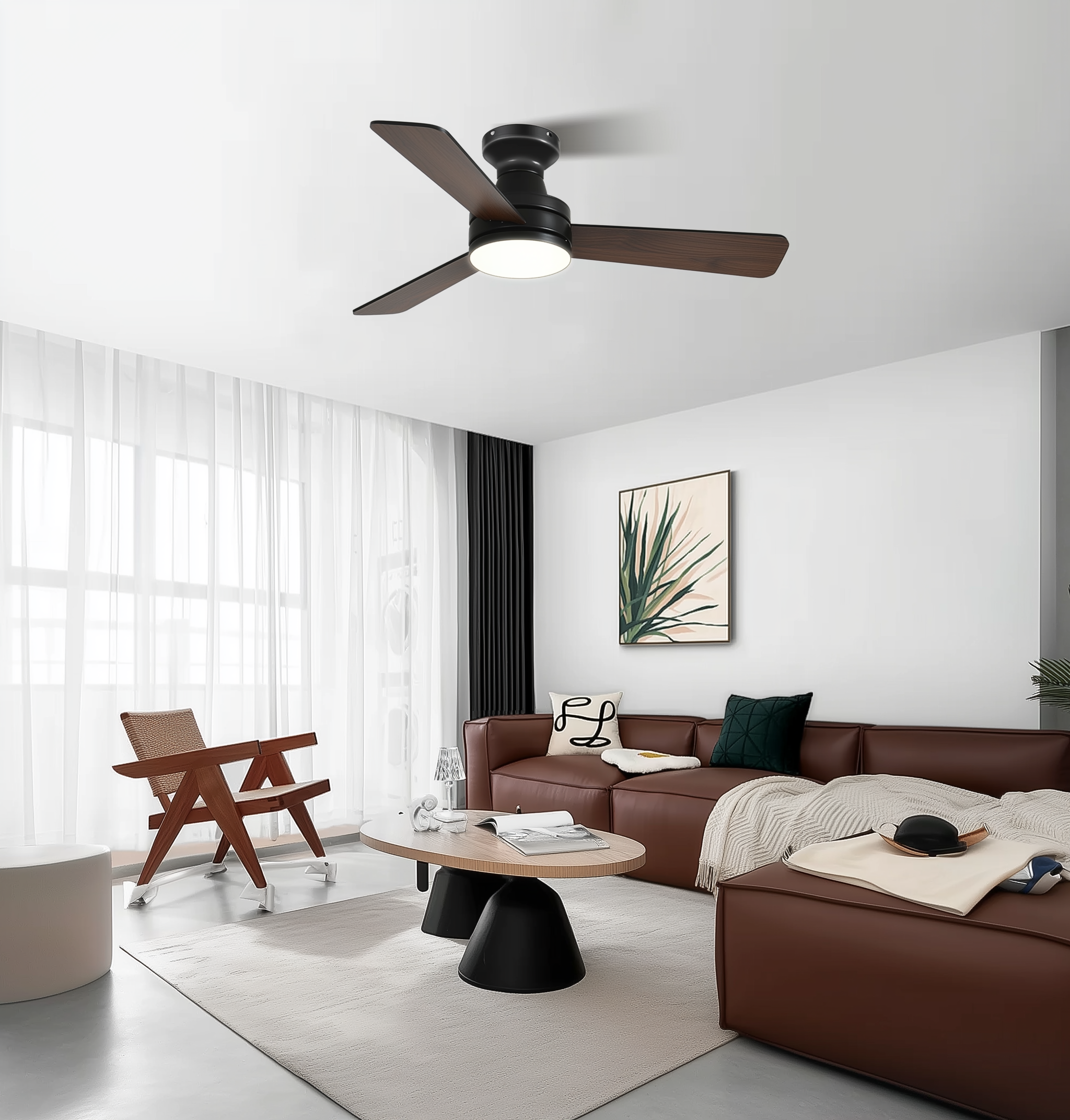
Why this problem requires immediate attention
Indoor air quality often declines unnoticed until occupants complain of dry throats, stale odour, or uneven thermal comfort; thus it is incumbent upon the homeowner to diagnose the matter with deliberation. While air purifiers and ventilation upgrades attend one part of the remedy, a properly chosen large ceiling fan with light may deliver immediate improvement in perceived comfort and assist in more equitable air circulation. Such fans—especially those with intelligent controls—address both comfort and energy efficiency, and they dovetail with a broader air-quality audit rather than substitute for it.

A concise diagnostic framework for the curious practitioner
Adopt a three-stage approach: observe, measure, and act. Observe patterns of discomfort (rooms that remain warm or cold, persistent odours, or dust accumulation). Measure with targeted instruments—CO2 monitors, particulate sensors (PM2.5), and hygrothermographs for humidity and temperature. Act by prioritizing interventions in spaces that show the worst indices. This problem-driven logic keeps expenditures proportional to the measured risk and avoids the folly of treating symptoms in rooms that are already satisfactory.
What to measure and why it matters
Key indicators are: CO2 (proxy for ventilation), PM2.5 (fine particles), relative humidity, and temperature stratification. High CO2 signals inadequate fresh-air exchange; PM2.5 correlates with health impacts in occupants. Relative humidity outside the 30–50% band promotes dust mite proliferation or condensational decay. For temperature imbalance, measure at floor, seated, and near-ceiling heights to reveal stratification that a fan can remedy by mixing air.

Selecting an intelligent ceiling fan: core specifications
When one upgrades to an intelligent unit, consider airflow (CFM), blade pitch, motor type, and lighting output (lumens). A fan rated with high CFM and modest noise is apt for large living spaces; blade pitch affects the volume of air moved, while a DC motor commonly yields finer speed control and superior energy consumption compared with an AC motor. Evaluate light quality—colour temperature and lumen output—and ensure the fan’s IP rating suits any semi-outdoor installation. Finally, confirm compatibility with your smart-home ecosystem and remote-control protocol to avoid later integration strife.
How to match fan size to room and role
Use a rule of thumb: rooms under 100 sq ft require a small fan; 100–225 sq ft call for 44–50 inch fans; larger living rooms demand 52 inches or more. For vaulted ceilings, consider downrods to preserve effective blade clearance. If the aim is both illumination and airflow in principal gathering spaces, prioritise models listed as large living room ceiling fans with lights that specify high CFM and uniform light distribution.
Common mistakes and how to forestall them
Brands and homeowners alike often err by underestimating three items: the effect of blade placement on airflow patterns, the need for precise motor control, and the interaction between fan speed and thermostat setbacks. Do not presume a fan’s nominal CFM on paper will translate to even room mixing if blades are improperly located. Likewise, cheap remote systems may lack discrete speed steps, impairing the fine control needed for comfort. Lastly, mismatching fan strategy and HVAC setpoints diminishes the savings expected from combined use—test the ensemble with real-world runs before finalising settings. —
Installation nuances and integration tips
Attend to electrical supply (dedicated circuit where required), canopy clearance, and secure mounting—especially for heavy models. If integrating with a smart hub, verify the protocol (Zigbee, Z‑Wave, Wi‑Fi) and whether the fan supports scene programming or simple on/off and dim commands. For outdoor or semi-exposed locations, heed IP ratings and corrosion-resistant finishes. A measured trial run after installation—ideally at different thermostat setpoints—will reveal whether the fan aids stratification or merely stirs air without improving perceived comfort.
Real-world anchor: energy and comfort outcomes
Consideration of verifiable guidance aids judgement. The U.S. Department of Energy observes that proper use of ceiling fans allows raising the thermostat setting by about 4°F without loss of comfort—an insight that translates to quantifiable savings when cooling loads are significant. In practice, residences in warm climates that combine sensible airflow (high CFM, correct blade pitch) with modest thermostat adjustments see measurable reductions in compressor runtime. Thus, the fan is both a comfort device and an efficiency lever.
Common pitfalls in audits—and quick remedies
Auditers sometimes rely solely on single-point CO2 readings or on occupant impressions without corroborating instruments. Remedy this by taking repeat measurements at different times of day and under varied occupancy. Another failing is neglecting the light component of combined fan-and-light fixtures; poor photometrics or inadequate lumen counts undermine the utility of an otherwise well-specified fan. Where possible, perform a short A/B test with and without active fan operation to gauge the net effect on temperature uniformity and perceived comfort.
Advisory: three golden rules for selection and deployment
1) Measure first, specify second: let CO2, PM2.5, humidity, and stratification guide your choice of fan size, CFM, and control sophistication. 2) Match motor and controls to the task: favour DC motors and intelligent remotes where fine speed modulation and scenes will be used; ensure protocol compatibility with your hub. 3) Test the system end-to-end: validate that fan airflow, light output (lumens, colour temperature), and thermostat strategy operate in concert before sealing the installation.
These rules will steer one away from costly rework and toward durable gains in comfort and efficiency. For a trustworthy synthesis of smart control, robust motor design, and suitable sizing—exactly the qualities that make the upgrade both prudent and practical—consider the solutions supplied by Orison. —